Making a Good Impression
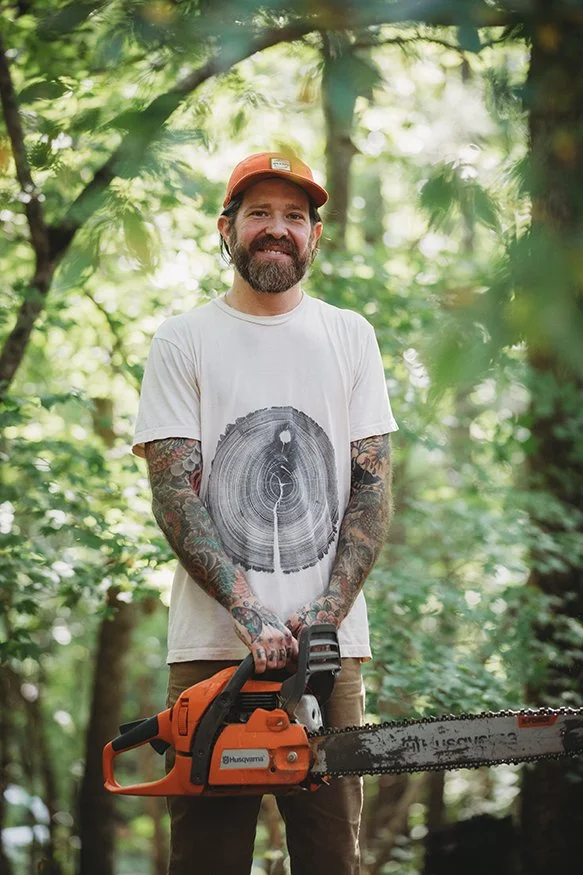
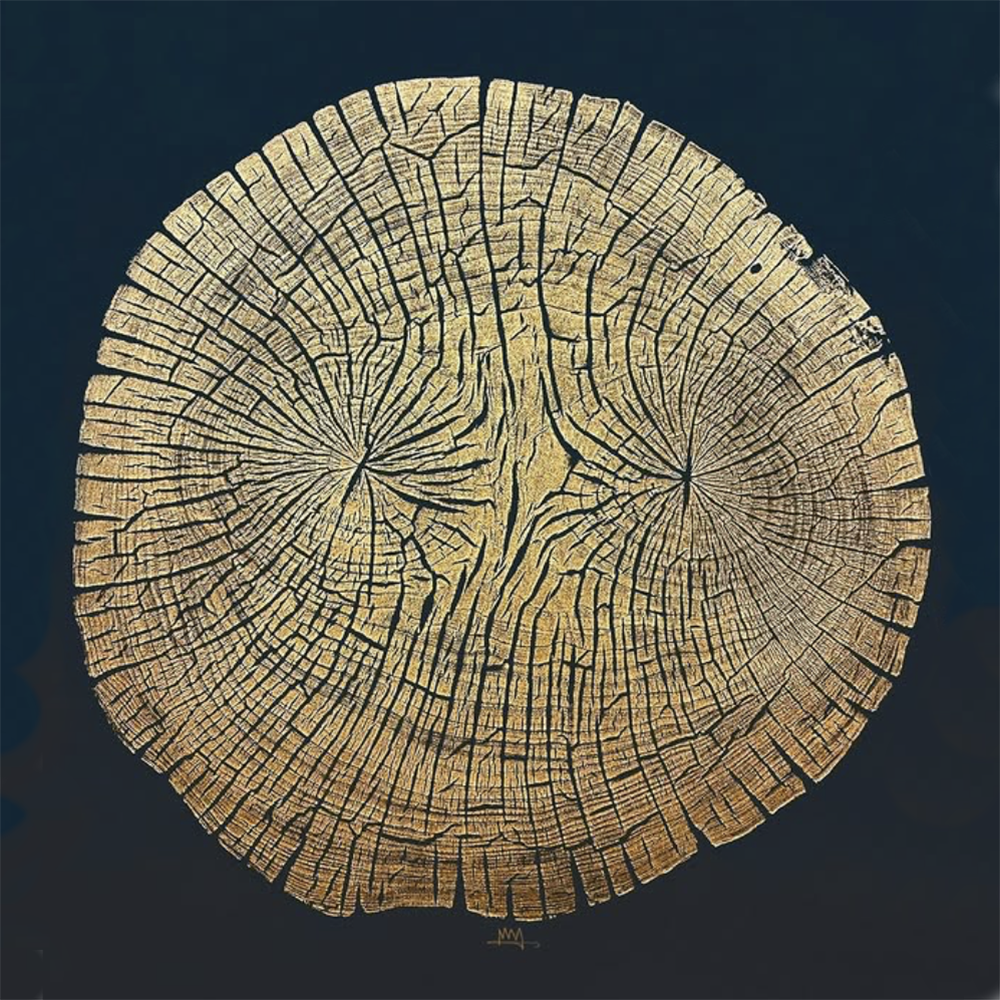
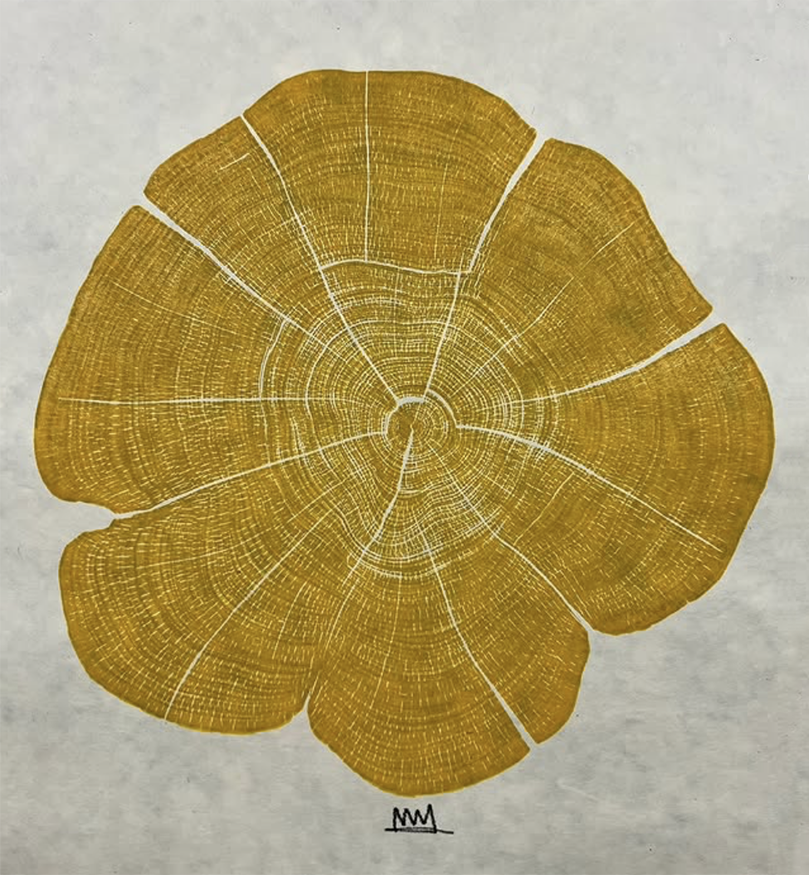
Local Artist Stephen King spent his early years in downtown Columbia, but his dad owned property in Chapin, and he and his family would come out and walk the land when he was young. He called himself a “city boy” back then: heavy into skateboarding, hip hop, sneakers, fashion, and all things urban. Had he not moved to Chapin in 7th grade, Stephen likely would have remained a true “city boy”. Perhaps that’s why the subject of his artwork is so unexpected. The forty-something year-old, tattoo-covered (and I do mean covered) artist creates work that showcases, of all things, the simple, unique beauty of nature.
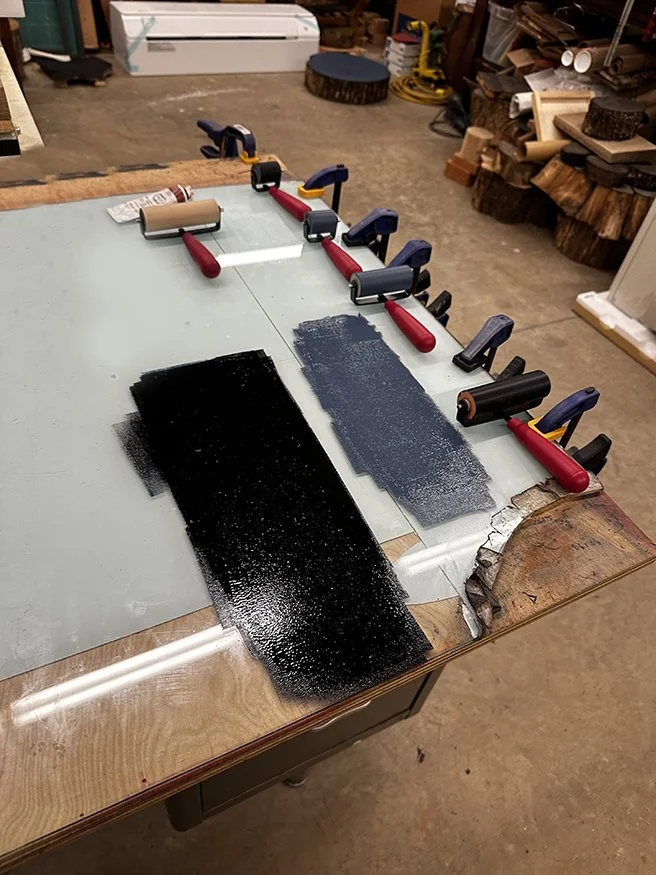
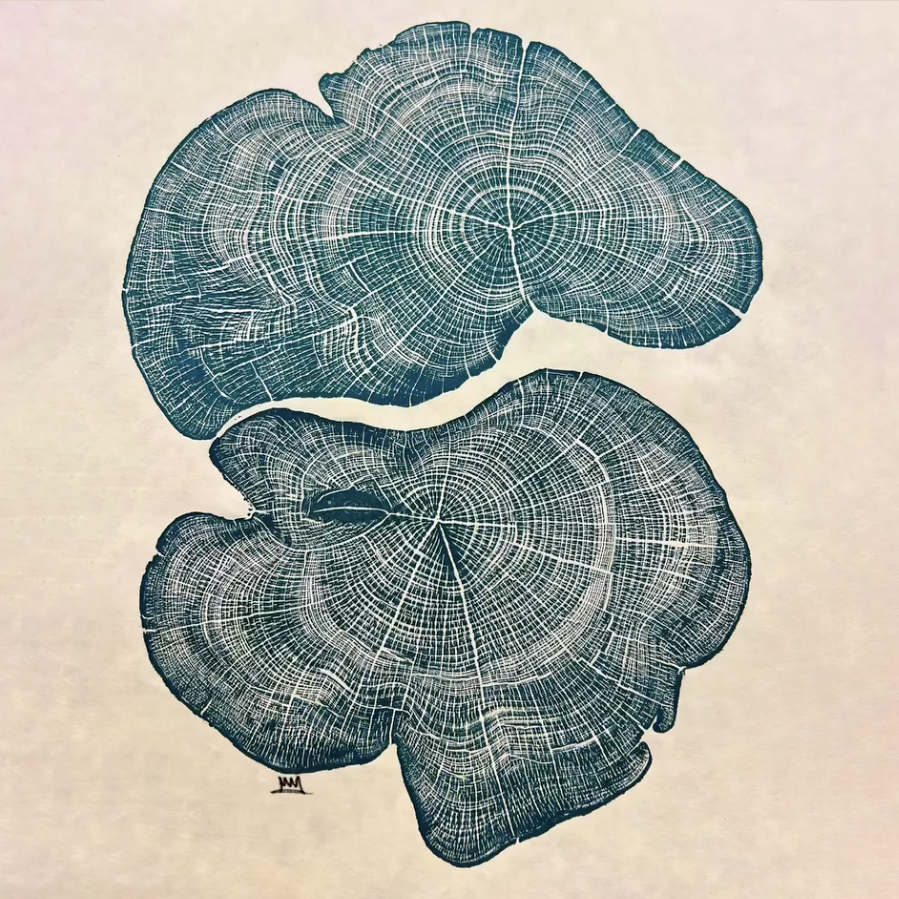
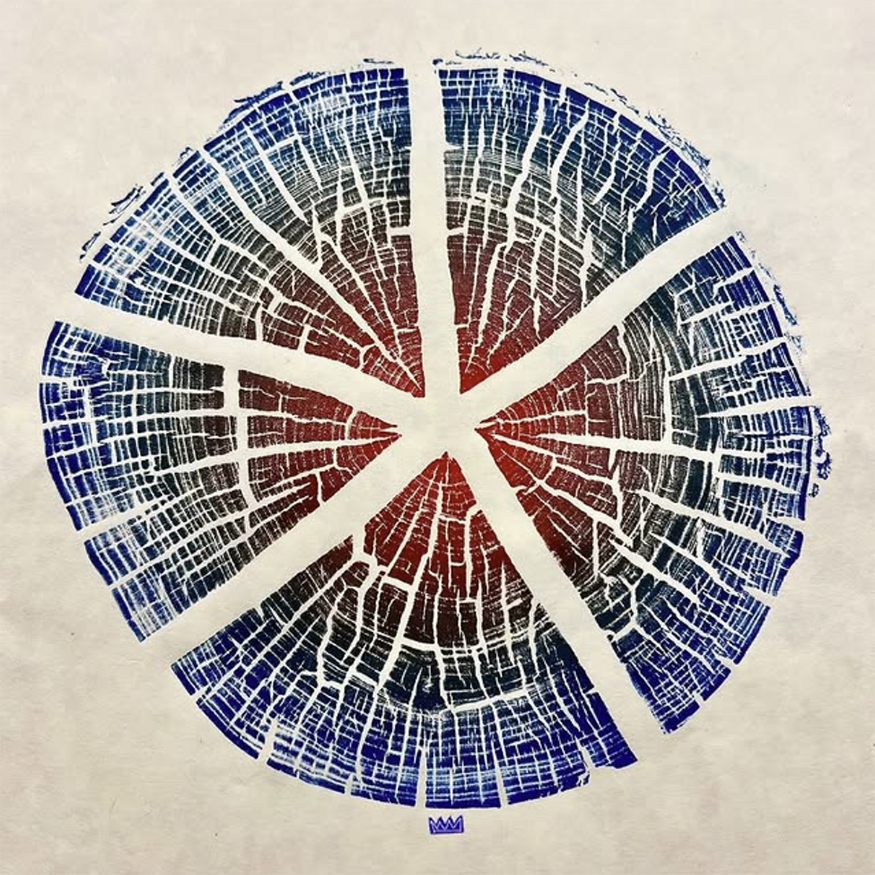
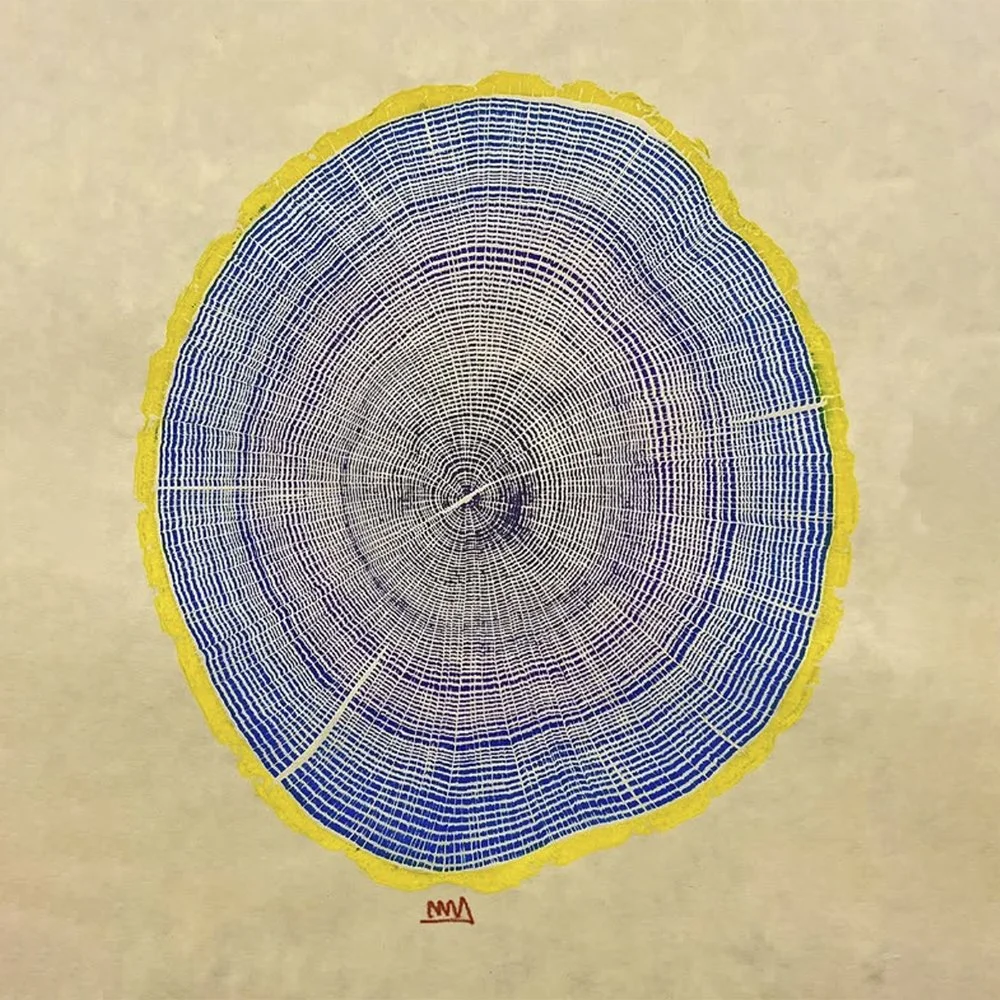
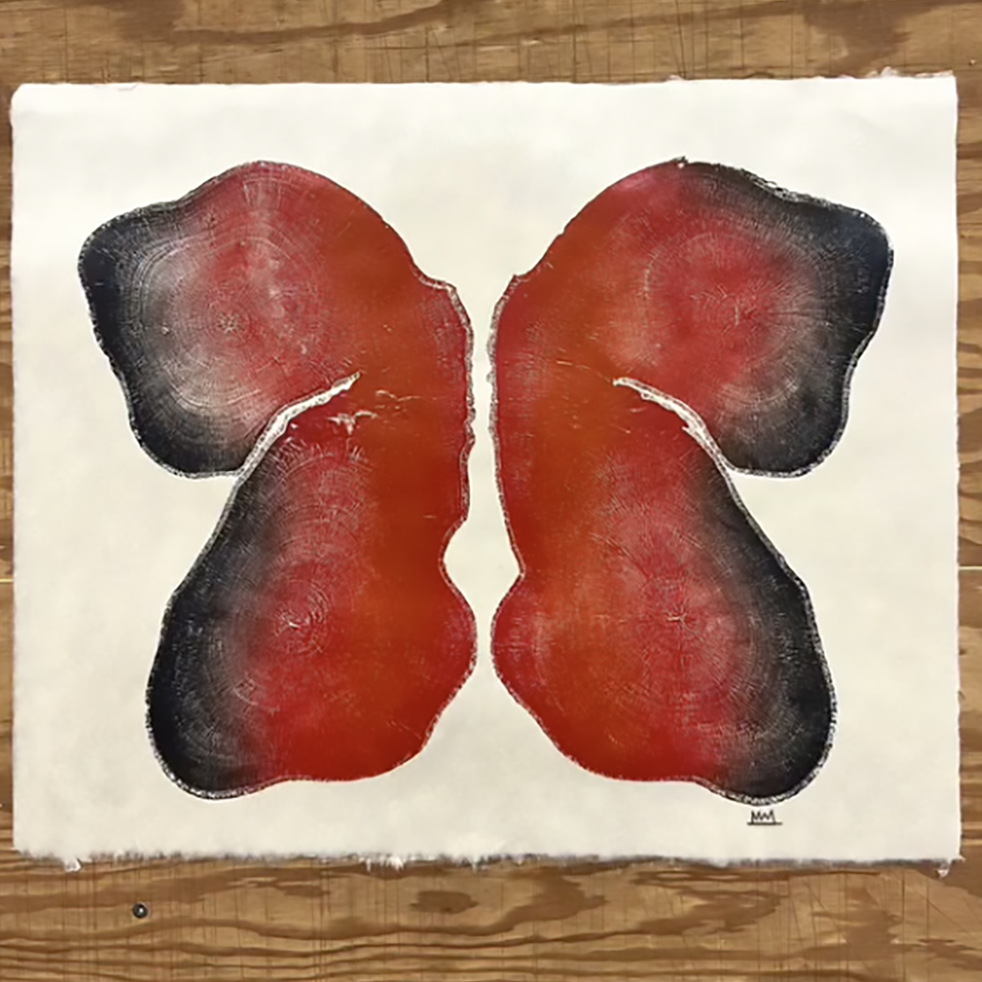
These days, on a large private lot beyond a log cabin, you’ll find Stephen in his studio making relief prints of fallen trees. New York City’s Museum of Modern Art describes relief printing as “a general term for those printmaking techniques in which the printing surface is cut away so that the image alone appears raised on the surface.” Raised areas of the printing surface are inked and printed, while the depressed areas do not pick up the ink and remain bare. A simple example of a relief print is that of a rubber stamp.
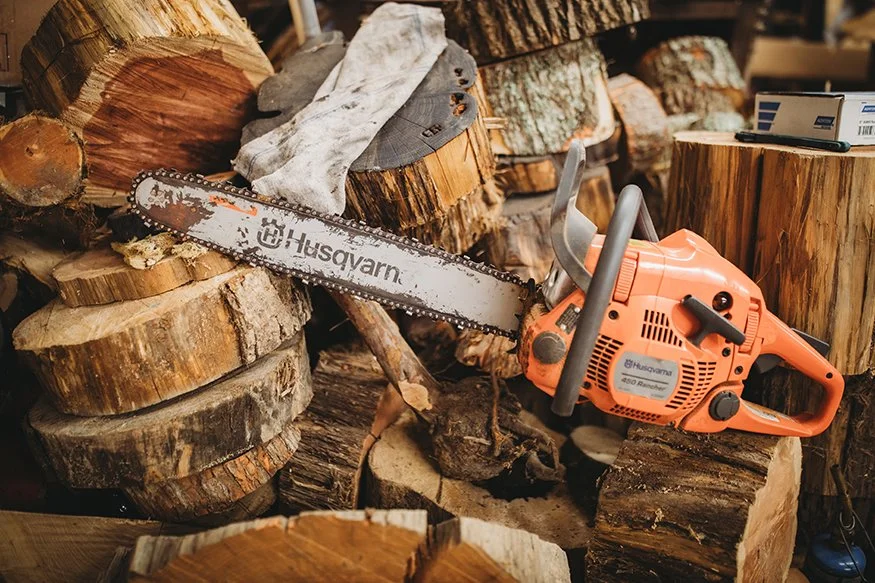
Immediately upon entry into his studio, guests are greeted by a large pile of tree stumps. They are curing, I’m told – one of many steps in his procedure. “No trees were injured in this process,” Stephen jokes, though he is also quite serious. He has never cut down a tree to create his art, instead, opting to find already-fell trees. He later explains that he cares about the earth and his carbon footprint, but recognizes that the only behavior he can control is his own. Beyond the stumps in the entry way, there are more, ink-stained stumps, a variety of work tables, table saws, chain saws, tools, inks, paper, and a few MacGyveresque-looking contraptions used in his semi-secretive creative process. It’s apparent that his creative process (which took him 15 years to perfect) is showcased in his product, just as much as the trees are.
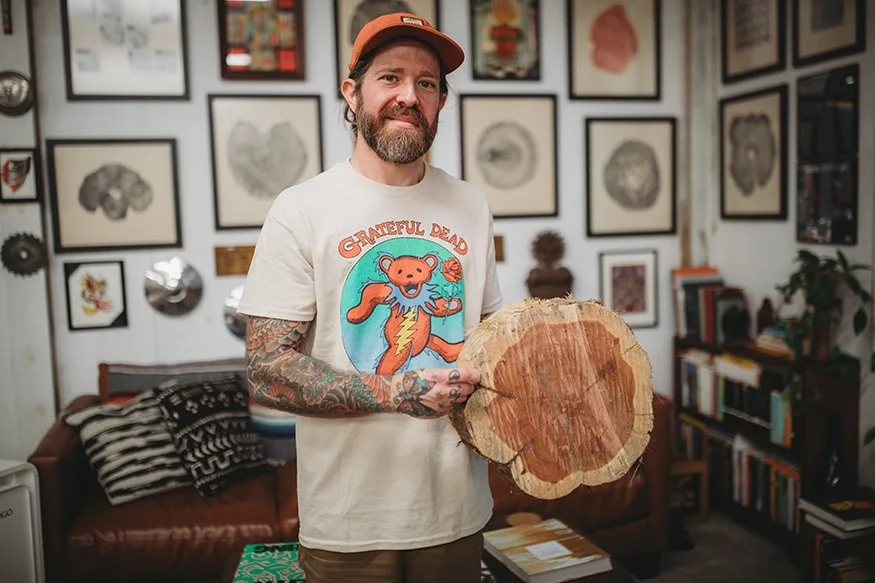
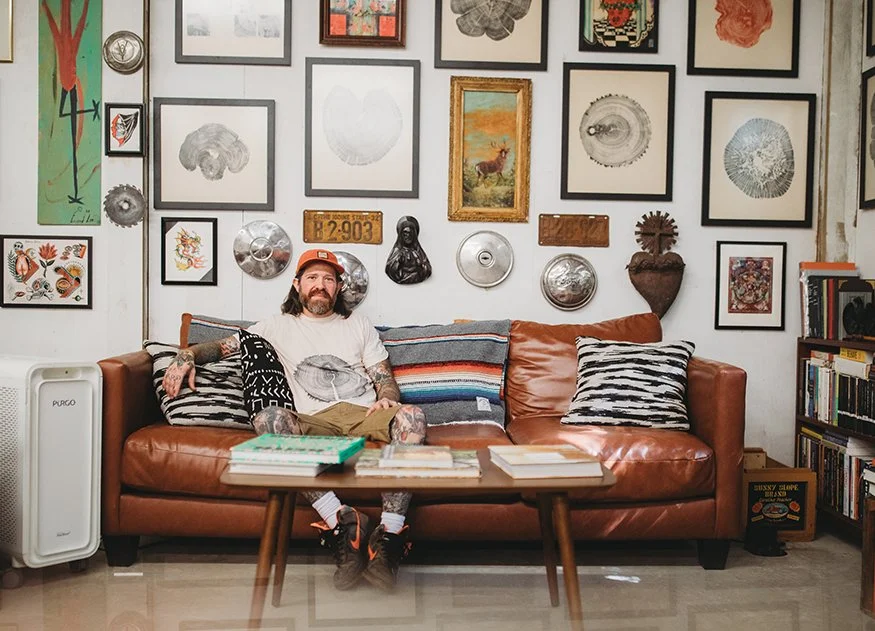
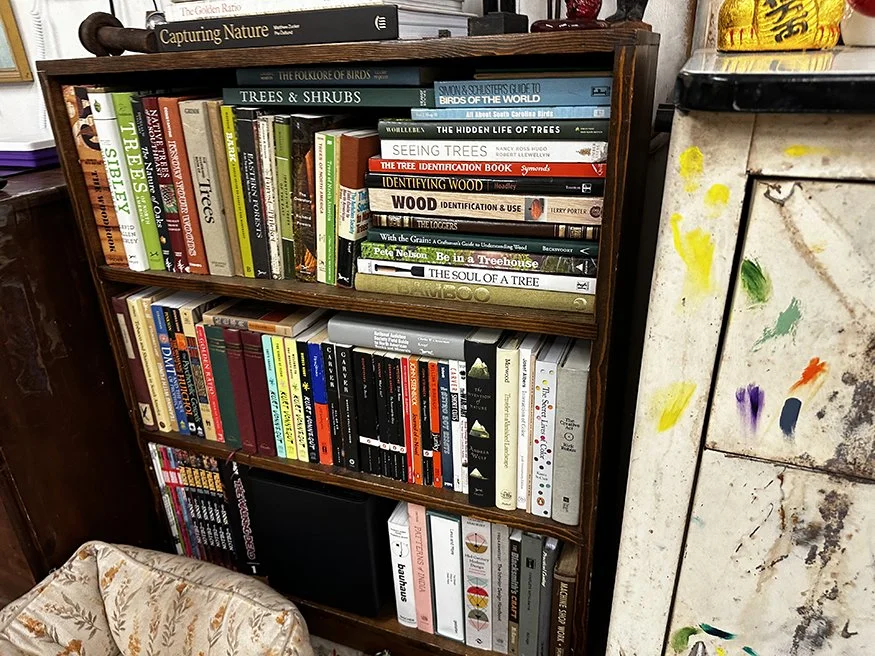
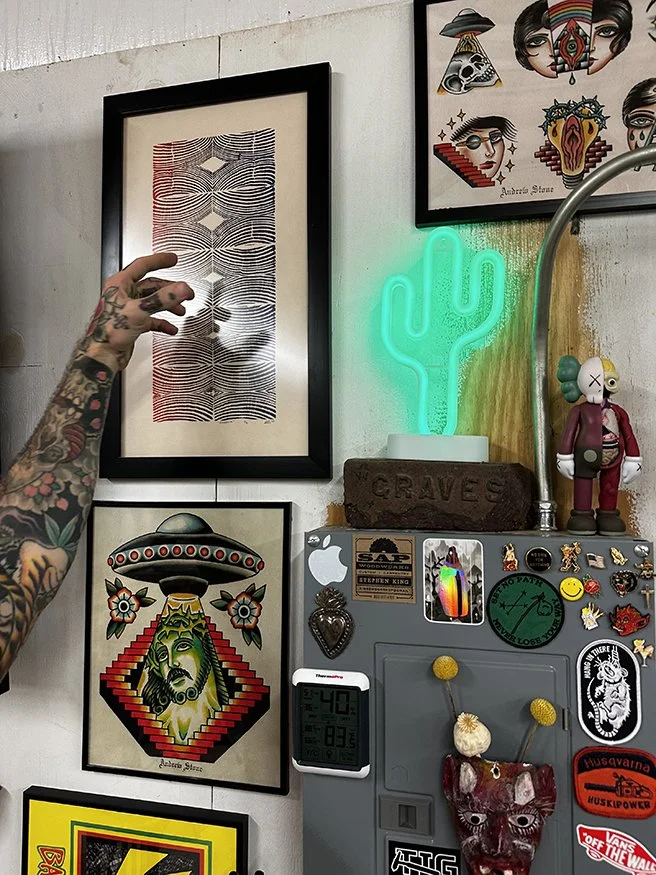
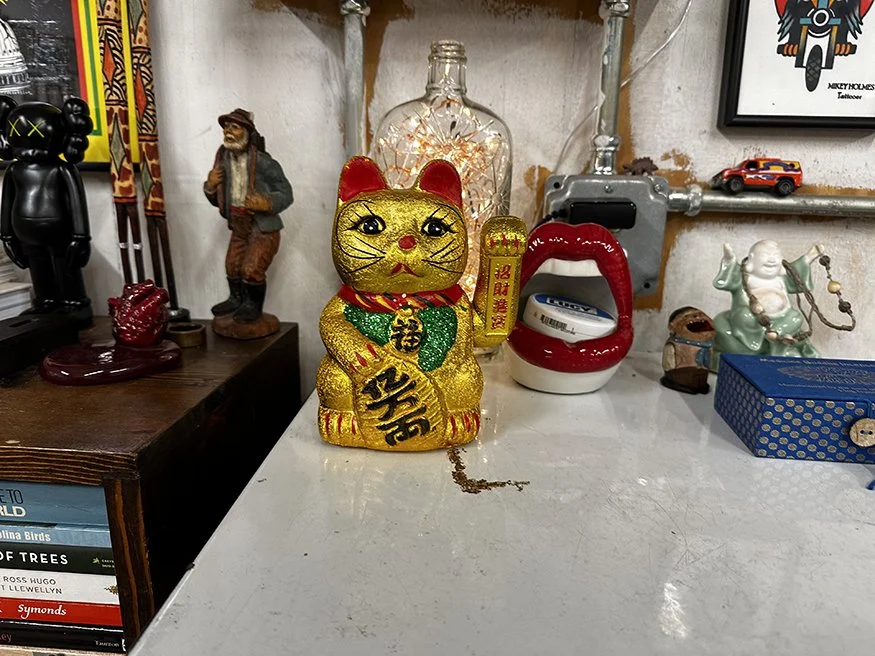
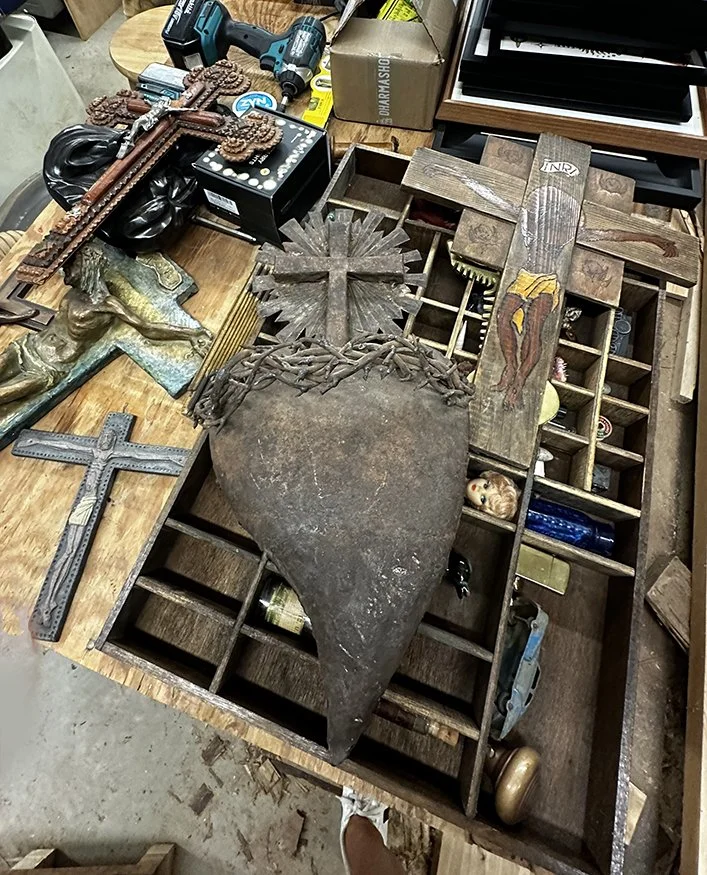
He invites me to sit in a comfy living room area that one might expect to find in a downtown New York City wine bar. Shelves are lined with a myriad of books about trees, art, woodworking, tattoos, human behavior, religious iconography and much more. There are skateboards, a collection of fishing lures, a cactus-shaped neon lamp, and a display of found arrowheads. A host of vintage toys, both in and out of their boxes, novelty items, religious icons, and a maneki-neko (a waving toy cat revered in Japan for its ability to bring good luck) adorn flat surfaces and collectively tell a story. Along with Stephen’s own work, the walls are lined in album covers, concert posters, crosses, tattoo art, skateboard stickers, and even a Nike SB shoe box. The eclectic decor showcases Stephen’s many facets: a city boy, nature lover, former tattoo apprentice, woodworker, reluctant hipster, and artist.
Stephen started posting his work on Instagram in 2012, and over time he gained followers. In February of this year he posted a reveal video of one of his prints being peeled off of its stump. The post went viral with over 20 million views brought with it 118K followers.
Today, Stephen’s work hangs in London, Australia, Japan, the Netherlands, South Africa, Canada, Mexico City, Italy, France, Germany, and of course the U.S. He likes selling mostly direct to consumer on the internet and chipping away at the traditional gallery structure. There’s something satisfying about bucking the system, but he swiftly and respectfully acknowledges the significance that galleries play within the art world. “When a gallery wants to show an artist’s work, it’s a special kind of validation.”
““I aim to give trees a second chance at being seen.” ”
In the old days, Stephen would see a storm-felled tree on someone’s property and knock on the door to explain, “This is what I do… and I am here to ask if I can cut a sliver of your dead tree…” In spite of his perhaps-unorthodox appearance, most would tell him to help himself. These welcoming experiences introduced him to the Chapin community of which, today, he is proud to be a part. Now a days, Stephen procures his trees through networking: there’s a bank of suppliers who regularly reach out to him with trees. Over time they have learned what kinds of trees appeal to Stephen. For example, perhaps the circumference of the trunk is unusual, or a tree has a split to the middle of it. Maybe one is partially hollow, or just very, very old… For Stephen, tree prints are no different than the very tattoos on his body. “Both are all about storytelling,” he explains. Interestingly, one of his favorite things about the prints is how each person sees his work in their own way. One person might see a flower in a tree print, while another person might see a seashell in that same print. “It blows my mind how someone can see something I’ve never seen before [in the same piece]”. The stories his prints tell vary from piece to piece, and person to person.
When he’s not creating his art, woodworking, or on social media, Stephen is a seeker who is curious about the intersection of science and science fiction. He believes in alternate universes, has a keen interest in the Fibonacci sequence and the golden ratio. As we sit in his studio relaxing to the music of Khruangbin, the deep thinker talks about the ebb and flow of life as an artist. “Everything comes in waves,” he explains. He applies it to his art: “Whenever you’re in the valley of that wave, you feel like you’re not on the radar anymore, but then you come back to the apex of the wave, and then all the calls come in.” On August 1, just when he started believing he had fallen off the art world’s radar completely, Stephen received confirmation that he would be getting a one-man show at Brookgreen Gardens in Murrells Inlet, SC from February through mid-March in 2025.
It’s an exciting time for him because it brings him a step closer to one of his goals. “My goal is to make people look at trees just a little bit differently, and I aim to give trees a second chance at being seen.” Indeed, through the vibrant yellows, reds, greens, blue, or stark black prints, whether they’re of cedar, pine, black locust, or maple, Stephen’s prints honor nature, tell a story and give trees new life. Perhaps his art work will help him live up to his legendary name. “With a name like “Stephen King, I knew I could never be a writer,” he jokes. Not to worry Stephen, while we’re no experts in the Fibonacci sequence, the golden ratio, print making, or organic modern art, when we asked about your future success as an artist, our Magic 8 Ball replied, It is decidedly so.
Addendum ~ 2026
Nowadays, Stephen is working on his newest project, a book called “Fingerprints of the Forest”. With tree prints from every state across the US, along with a journal of his travels and interviews with the local “Tree Ambassadors” who helped him procure the trees themselves, the book will literally and figuratively bring it all together. “In working on this project, I have learned even more that everything is connected,” Stephen explains. He hopes that when it’s completed, readers will more fully understand its underlying theme, “We should be running towards nature, not away from it.”
To see more of Stephen’s work, follow him on Instagram @sapwoodworking or go to sapwoodworks.com.